Activate RDNs
Teaching future physicians when to call a dietitian
The problem
Medical students get told to address nutrition. Nobody tells them where their job ends and the dietitian's begins. So they do the front half, ask about food and name the concern, and then stall at the handoff.
We saw this in our own students. When we asked one third-year pediatrics clerkship block (16 students) what they felt ready for, the lowest-rated item on the whole survey was making an effective referral: what to put in it, and what their role is after an RDN gets involved. It scored 3.06 out of 5. Five of the sixteen had never worked with an RDN in any way during the rotation. Twelve had never taken a nutrition elective. That's not a self-selected group. That's most students.
What we built
A three-hour interprofessional session for third-year medical students and graduate nutrition students, sitting at mixed tables. Breakfast and table talk, a short lecture with an RD panel, then an hour with Navigate, a 33-card game. Each card is a chronic-disease scenario, an intervention, a patient question, or a reflection prompt. Every card ends with someone saying a decision out loud in front of the other profession. Then two debriefs, small table and whole room.
The framework is Refer · Reinforce · Activate. The point was never the right clinical answer. It was: who is responsible here, what's realistic, what breaks in the system, and how does care keep moving.
Navigate won the 2025 Mary Abbott Hess Award for Recognition of an Innovative Food/Culinary Effort from the Food & Culinary Professionals practice group of the Academy of Nutrition and Dietetics.
Who did it
I designed the session and the game and led it at the University at Buffalo. Catherine Brown, MS, RDN, CDN, LDN, FAND (Flourish Nutrition) and Beth Machnica, MPH, RDN, CDN (Buffalo Niagara Medical Campus) co-developed it and sat on the RD panel. Physician and RD faculty facilitated the tables.
Where and how long
Jacobs School of Medicine and Biomedical Sciences, University at Buffalo. Run every year for five years with roughly 90 learners each time, revised after every run.
What we measured, and what we found
In January 2026 we gave students a short five-item survey before and after. Independent samples, so pre and post are different students in the same room, not matched pairs. Pre n=89, post n=98. Five-point agreement scale, Mann-Whitney U.
Four things moved, all at p<0.001:
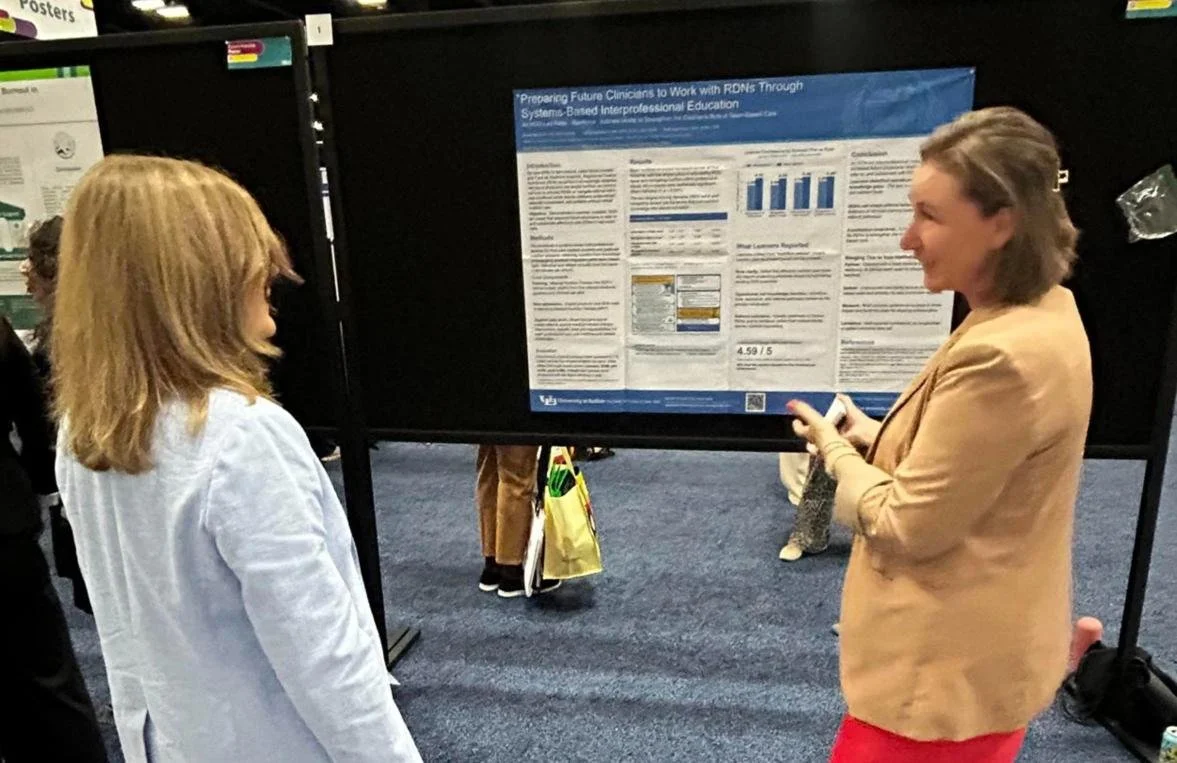
Being able to explain what an RDN brings to a patient: 3.53 to 4.51
Knowing where their own scope ends: 3.46 to 4.36
Seeing how RDNs fit into care models: 3.74 to 4.46
Recognizing what gets in the way: 3.80 to 4.39
After the session, students rated their likelihood of engaging an RDN at 4.59 out of 5, and 88% said the session was valuable. When we asked what gets in the way of good nutrition care, 76% named something structural: cost or coverage, food access, time, or the referral process itself.
These are self-ratings, taken the same day. They tell us what students believe and feel ready for. They don't tell us whether a referral got written. That's the question the next phase is built around.
This ran as routine program evaluation, not human subjects research.
What changed because of it
Students kept telling us the hard part was the system, not the science. So in May 2026 we added a fifth category of cards: System and Workflow. Walking a referral through. Closing the loop. Scope on the spot. What happens when the plan and the coverage don't match. The cohort we measured used the four-category deck. The five-category deck is the current version.
What's next
Three things, all underway.
A measured starting line for the whole class. In July 2026, every first-year student at UB took an eight-item survey before and after a Day 1 orientation session on recognizing when nutrition matters, what belongs to the physician, and when to involve an RDN. 189 students took part; 176 had matched pre and post responses. The biggest shift was on role clarity: understanding what's the physician's job versus another team member's went from 2.90 to 4.28. Recognizing when to bring in an RDN went from 3.10 to 4.15. The smallest shift was on whether nutrition will matter in their future practice, 4.56 to 4.82. They walk in already believing that. Those same eight items are now on the third-year clerkship survey, the pediatric resident survey, and the pediatric faculty survey, word for word, so we can look across the whole pipeline.
A behavior measure. The Referral Task in our NME microcredential crosswalk is a scored exercise where a student writes an actual referral. That's the first piece of the assessment that looks at what a student does, not what they say.
Other sites. The materials are free. We're asking programs that run the session to keep the same short set of pre/post items, so we end up with data from several schools instead of one. If you teach in a medical school, residency, or health professions program, you can bring this in. Join the collaboration and get the materials.