Training Future Physicians to Activate Dietitians in Patient Care
A short, practical session that teaches medical students when nutrition matters, what the physician’s job actually is, and how to use an RDN well.
Developed at the University at Buffalo Jacobs School of Medicine and Biomedical Sciences.
Winner of the 2025 Mary Abbott Hess Award for Recognition of an Innovative Food/Culinary Effort.
Most of the people who can start this are dietitians.
If you teach, precept, or consult in a medical school, residency, or other health-professions program, you can bring this in. You don’t have to own the course. We’re looking for sites to run the activity and keep the same short set of measures, so we end up with data from several programs instead of one more single-site study.
Physicians don’t need to become dietitians. They need to know when to call one.
Medical students get told to address nutrition. Nobody tells them where their job ends and the dietitian’s begins. This session teaches one skill: spot when nutrition is the issue, handle the part that belongs to you, and get an RDN involved for the rest.

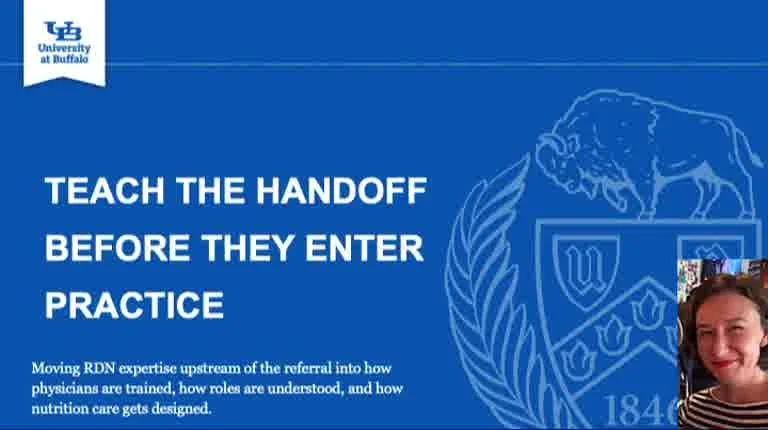
Recorded September 2026 for the Academy of Nutrition and Dietetics Council on Future Practice. Nine minutes on why this work exists — the case for training physicians to recognize, respond, and activate. Read the transcript.
Get the tools
Free to use and adapt at your institution, with attribution. Everything is versioned and dated, so sites running the same materials can be matched up later.
Building an ACEND Nutrition in Medical Education microcredential? This session is a ready-to-run module for Unit 3. The crosswalk below shows the mapping and includes a summative assessment.
Using RDNs in Clinical Practice
A one-page guide for medical students: when to think of an RDN, the exact EHR referral language to use, what happens after the referral, and what the physician is not expected to do.
The five items verbatim, what each one measures, and how to administer it so your results can be compared with other sites. Version 1.0, September 2026.
The full run of show, the card sequence, table norms, both debriefs, and what to keep if you adapt it. Version 1.2, September 2026.
For ACEND-accredited programs building the Nutrition in Medical Education microcredential: how this session covers Unit 3, indicator by indicator, plus a scored Referral Task to use as the summative assessment. Version 1.0, October 2026.
All four map to Domain 4 of the HHS Medical Education Nutrition Competency Framework (Competencies 39 and 40) and to Unit 3 of ACEND’s Nutrition in Medical Education Microcredential — collaboration, referral, and patient management.
What we found
Independent pre/post samples from the January 2026 cohort at the University at Buffalo — third-year medical students and graduate nutrition students. Pre n=89, post n=98. Five-point agreement scale, compared with the Mann-Whitney U test. All four changes below were significant at p<0.001.
Articulation of RDN value 3.53 → 4.51 (+0.98)
Navigation within scope 3.46 → 4.36 (+0.90)
Integration into care models 3.74 → 4.46 (+0.72)
Recognition of system barriers 3.80 → 4.39 (+0.59)
These are the things that have to move before a referral actually gets made.
This ran as routine program evaluation, not human subjects research.
One institution, one session, one learner group. That’s why we need other sites.

What learners tell us
A separate needs assessment, run with one third-year pediatrics clerkship block (n=16), asked what students had actually done and what they felt prepared for.
They already believe it. They just can’t hand the patient over.
Highest-rated of ten items, at 4.38: lifestyle medicine is evidence-based care that complements conventional treatment, and I expect nutrition and lifestyle factors to be relevant in my future practice.
Lowest-rated of ten items, at 3.06: I understand how to make an effective nutrition referral, including what information to provide, and my role after an RDN becomes involved.
Twelve of the sixteen had never taken any elective nutrition, culinary medicine or lifestyle medicine experience. This is not a self-selected group.
What they did during the clerkship says the same thing. Ten of the sixteen took a food or feeding history five or more times. Five of the sixteen collaborated with an RDN not once.
Asked what feels hardest, they named the system and the handoff: barriers such as cost, time and food insecurity (9 of 16), identifying realistic next steps (8), knowing the physician’s role versus when to involve a specialist (7), and making an effective referral (7). Knowing what nutrition science a physician needs came last, at 3.
One block, one specialty, sixteen responses. It’s a signal, not a finding. But it points the same way as the larger dataset.
Help us learn whether this works across settings
If you’re an RDN working anywhere near a medical school, residency, or other health-professions program, this is for you. Faculty and program directors too. Adapt the activity to your setting. Just keep the same short set of measures.
Completing this form simply tells us you’re interested in discussing implementation or shared evaluation. It does not commit your institution to participation.
What would common measurement involve?
Partners may adapt the educational content to their own setting while keeping a small common set of pre/post items. That gives each site locally useful evaluation data and makes future pooled or comparative work possible. Any formal multi-site research activity, data sharing, or IRB requirements would be established separately, before any research data are exchanged.
Want help building it?
The materials and the network are free. Separately, Becklem Nutrition Solutions works with programs that want this built and measured properly: curriculum and faculty development, evaluation and outcomes, accreditation and competency alignment, speaking and advisory.
Niki Becklem is Health and Wellness Thread Leader in the Department of Pediatrics at the University at Buffalo, an ACEND lead program reviewer, and a member of the Academy’s Council on Future Practice.
At the center of the session is Navigate, an award-winning interprofessional card game — 33 cards of chronic-disease scenarios, interventions, patient questions and reflection prompts that mixed teams of medical and nutrition students work through together. The full kit is available on request.
About this work
Project team
Nicole Becklem, MS, RDN, CCMS — Founder and Principal, Becklem Nutrition Solutions LLC; Health and Wellness Thread Leader, Department of Pediatrics, University at Buffalo
Catherine Brown, MS, RDN, CDN, LDN, FAND — Clinical Lead, Flourish Nutrition
Beth Machnica, MPH, RDN, CDN — Director of Health and Well-Being, Buffalo Niagara Medical Campus
Developed and delivered as an interprofessional education session at the University at Buffalo, refined annually over five years.
Presented at
FNCE 2026 — Preparing Future Clinicians to Work with RDNs Through Systems-Based Interprofessional Education
ACLM 2026 — Training Future Physicians to Activate Dietitians in Lifestyle Medicine Care
Council on Future Practice, Academy of Nutrition and Dietetics — recorded presentation
Recognition
Navigate, the interprofessional card game at the center of the session, won the 2025 Mary Abbott Hess Award for Recognition of an Innovative Food/Culinary Effort — Food & Culinary Professionals, Academy of Nutrition and Dietetics.
Suggested citation
Becklem N, Brown C, Machnica B. Refer · Reinforce · Activate: preparing clinicians to work with RDNs through systems-based interprofessional education. Becklem Nutrition Solutions LLC; 2026.
Using these materials
Educational use and local adaptation are encouraged with attribution. Every file carries a version number and date. If you are using the common evaluation items, please tell us, so that sites using the same measures can be connected to one another.
Contact
Page last updated September 2026. Materials current as of the versions listed above.